
Introduction
Africa stands at a pivotal moment in its energy transition. With 563 million people lacking basic energy access in 2023, and the majority employed in resource-based sectors such as mining and forestry, the continent faces the dual challenge of expanding energy access while decarbonising its systems. Achieving a just, inclusive, and sustainable energy transition is not merely a technical issue – it is a social, economic, and political imperative. One powerful but underutilised tool in this process is technology assessment.
What is Technology Assessment?
Technology assessment is a systematic process for evaluating the potential, risks, and impacts of technological innovations – existing, emerging, or future – within a specific societal context [1, 2]. It goes beyond technical feasibility to consider the broader social, economic, environmental, ethical, and political implications of technology adoption and development.
At its core, technology assessment aims to:
- Identify and analyse the direct and indirect effects of technologies on society, the environment, and the economy.
- Anticipate unintended consequences and provide early warnings about potential risks or disruptions.
- Support evidence-based decision-making by offering neutral, factual input to policymakers, industry leaders, and communities.
- Facilitate inclusive stakeholder engagement, ensuring that diverse voices – including experts, citizens, marginalised groups, and affected communities – are considered in the assessment process.
- Promote sustainable development by integrating long-term perspectives and balancing trade-offs between economic growth, social equity, and environmental protection.
Technology assessment is not a one-size-fits-all approach. It encompasses various forms and methods, such as classical, participatory, constructive, real-time, sustainability-focused, ethical, and interdisciplinary assessments. Each form is tailored to specific contexts, purposes, and stakeholder needs, and may be applied at different stages of technology development – from early innovation to large-scale deployment.
In the context of energy transitions, especially in Africa, technology assessment is redefined as: a deliberate effort to assess the potential and impacts of technological change in an evolving energy system, with the aim of advancing sustainability, guiding design selection, and optimising resource utilisation for sustainable development [2].
This means technology assessment is not just about evaluating gadgets or infrastructure – it involves understanding how technology interacts with complex social, political, and economic systems, and ensuring that transitions to cleaner energy are just, inclusive, and contextually relevant.
Why Africa Needs Contextualised Technology Assessment
Most technology assessment frameworks originate from Europe and the USA, where energy systems, governance structures, and stakeholder dynamics differ significantly from those in Africa. African countries have diverse energy needs, varying levels of technological capacity, and distinct socio-political realities. For example, while South Africa is investing in green hydrogen, Botswana is focused on solar expansion. Yet, there is little information on how these technologies are selected and assessed for their broader impacts.
A tailored technology assessment framework can help African countries:
- Identify the most suitable technologies for local contexts.
- Assess impacts across sustainability dimensions – social, economic, and environmental.
- Engage stakeholders inclusively, ensuring that voices from mining communities, women, youth, and rural populations are heard.
- Support evidence-based policy choices that balance energy access, job protection, and environmental goals.
The Evolving Forms of Technology Assessment
A recent study identifies ten forms of technology assessment, each with its own strengths and limitations:
- Classical Technology Assessment: Focuses on early warning and policy alternatives.
- Participatory Technology Assessment: Engages the public and encourages debate.
- Constructive Technology Assessment: Involves users and communities from the outset.
- Real-time Technology Assessment: Integrates social values into innovation processes.
- Indicative Technology Assessment: Evaluates the state of the art of technologies.
- Technology Sustainability Assessment: Places sustainability at the core.
- Prospective Technology Assessment: Shapes technology goals based on anticipated consequences.
- Interdisciplinary Technology Assessment: Collaborates across scientific disciplines.
- Ethical Technology Assessment: Identifies and addresses ethical concerns.
- Hermeneutic Technology Assessment: Anticipates future narratives and expectations.
No single form can address all the complexities of Africa’s energy transition. Instead, a transdisciplinary, action-oriented approach is required – one that adapts to evolving energy systems and incorporates diverse perspectives.
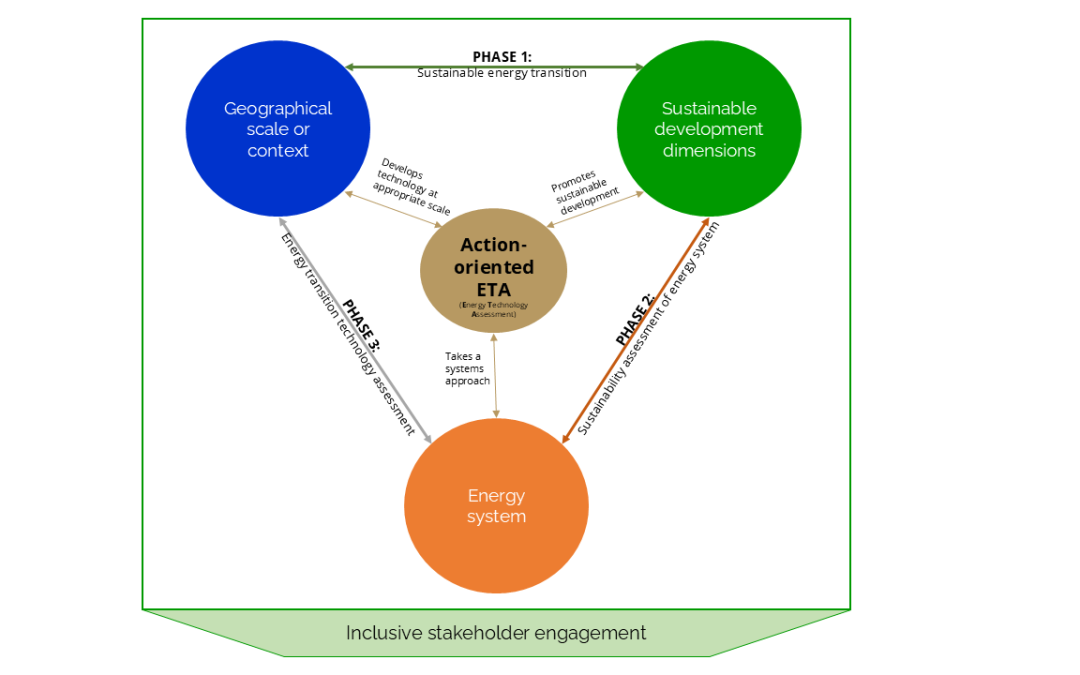
A Three-Phased Framework for Africa
The study [2] propose a practical, three-phased framework for implementing technology assessment in Africa’s energy transitions:
Phase 1: Demonstrate the Need and Scope
- Define the purpose of the energy transition.
- Map stakeholders, including marginalised groups.
- Prioritize technologies based on local needs and policy contexts.
Phase 2: Assess Sustainability
- Specify how prioritised technologies fit within the energy system.
- Define and select indicators across social, economic, and environmental dimensions.
- Use inclusive engagement to capture gender, youth, and community perspectives.
Phase 3: Conduct the Technology Assessment
- Refine the scope and methods based on previous phases.
- Assess technologies along the value chain.
- Communicate findings to inform policy, public debate, and technology design.
Lessons from South Africa’s Green Hydrogen Pilot
A recent UNCTAD pilot project in South Africa demonstrates both the potential and challenges of technology assessment. While the project initiated support for institutionalising technology assessment, it relied heavily on expert-driven processes and missed opportunities for broader stakeholder engagement. The experience underscores the need for frameworks that are not merely imported, but adapted and co-created with local actors.
Conclusion and Recommendations
For Africa, technology assessment is more than a technical exercise – it is a pathway to inclusive, sustainable development. By adopting action-oriented, context-sensitive technology assessment frameworks, African countries can:
- Ensure that energy transitions are just and equitable.
- Make informed decisions about which technologies to invest in.
- Foster stakeholder support and social acceptance.
- Identify and address sustainability and policy implications.
As the continent moves towards universal clean energy access, technology assessment can serve as a compass guiding policymakers, communities, and investors through the complexities of change.
Endnotes